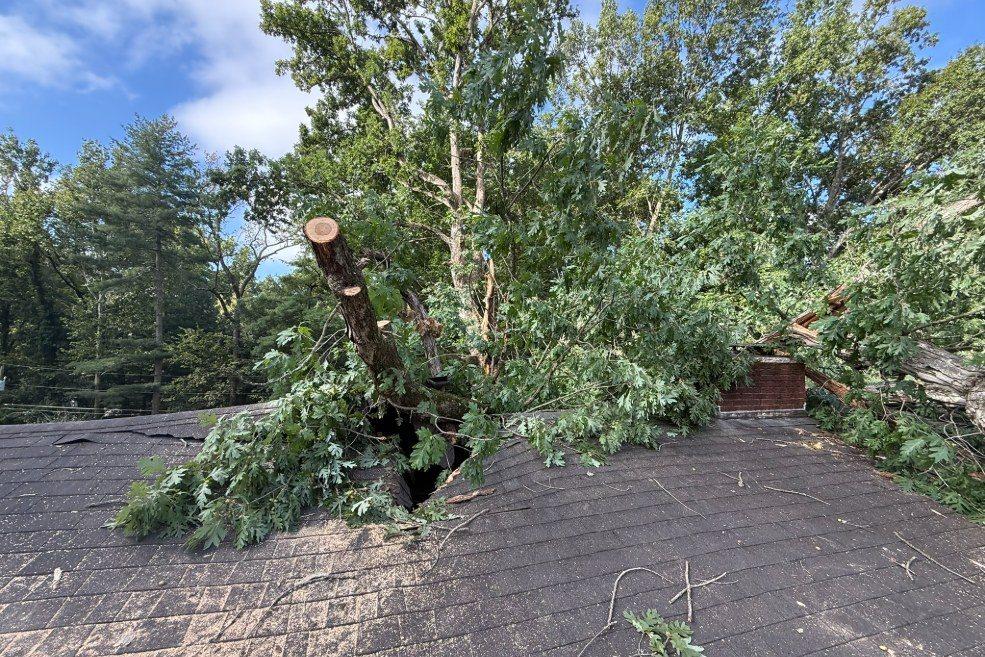
Severe thunderstorms and straight-line wind
Mostly March through July, with a second run in late fall. Any month is possible.
Straight-line wind from a thunderstorm does more tree damage in Missouri than tornadoes do, simply because there is so much more of it. A severe thunderstorm warning means wind of 58 mph or more, or hail an inch across. A derecho, a line of storms that keeps its wind up for hundreds of miles, can flatten a whole county's weak trees in an hour.
Wind finds the weak spot that was already there: a dead limb, a tight V where two trunks meet, a root plate loosened by wet ground. Fully leafed trees in May catch far more wind than bare ones in January.
Before
- Walk the yard once each spring. Dead limbs, cracks, mushrooms at the base, a new lean: have a tree company look before the season, not after.
- Get dead and hanging limbs over the roof, the driveway and where the kids play removed first. That is the cheapest storm work you will ever buy.
- Know where your tree is relative to the service drop (the line from the pole to your house). Trees in that line are the utility's call to trim near the wire, and yours away from it.
- Bring in or tie down anything that flies: trampolines, patio umbrellas, empty trash cans.
- Have a way to get warnings at night. A phone with Wireless Emergency Alerts on, or a NOAA weather radio, wakes you. Sirens are for people outdoors.
During
- Go inside and stay away from windows. A severe thunderstorm warning for your county means act now, not look outside.
- Thunder means lightning is in range. Wait 30 minutes after the last thunder before going back out.
- If a tree comes through the roof, get everyone out of that room and away from the wall under it. Do not go on the roof in the storm.
After
- Look for lines first. Any downed wire, or a tree or limb touching one, is live until the utility says otherwise. Call them, not a tree company.
- Photograph everything before anyone moves a branch: the tree, the roof, the car, the fence. Your insurer will ask.
- A tree that is still standing, with no new lean and no cracks, is as safe as it was before. Do not let the storm panic you into cutting a healthy tree.
- Limbs on the ground are yard work. Limbs in the tree, split trunks, anything under tension and anything on a structure are a tree company's work. Hangers hurt people every spring.
- Get a written estimate from a local company. Nobody who knocks on your door after a storm.
The mistake: Cutting a hanging limb from a ladder. The limb drops, the ladder goes, and the emergency room is full that week already.
Sources: Ready.gov: thunderstorms and lightning, National Weather Service: wind safety, Missouri Department of Conservation: tree care tips after a storm, Missouri Department of Conservation: check large trees for safety issues
Tornadoes
Peak April through June, with a smaller peak in November and December. Night tornadoes are common here.
Missouri averages a few dozen tornadoes a year. Most are short and weak, and even those strip a yard. A watch means conditions are right; a warning means one is on the ground or about to be, and you have minutes.
Tornado damage to trees is total and local: a strip of snapped and twisted trunks, with the next street untouched. The danger afterward is the pile, with lines, nails and gas lines mixed into it.
Before
- Pick your spot now: the basement, or the lowest floor in an interior room with no windows, a bathroom or closet under the stairs. Put shoes and a flashlight there.
- Mobile home or upstairs apartment: know where you will go instead, and go on the watch, not the warning.
- Turn on Wireless Emergency Alerts on every phone in the house, and keep one charged by the bed. Night tornadoes kill because people are asleep.
- Keep a copy of your insurance policy and photos of each room and the yard somewhere off the property, like your email.
During
- Warning for your county: go to your spot at once. Helmets or a mattress over you protect the head; most tornado injuries are from flying debris.
- Do not open windows, do not watch from the porch, do not try to outrun it in a car in town.
- In a car in open country with no shelter, get below the road grade in a ditch, away from the car, and cover your head. An overpass is not shelter; the wind speeds up under it.
After
- Stay put until the warning has expired; storms come in lines and the second cell is the one that catches people outside.
- Watch where you step: nails, glass and downed lines. Smell gas? Leave, and call the gas company from outside.
- Check on neighbors, especially anyone older or alone. Text rather than call so lines stay open.
- Photograph everything, then make the house weather-tight (tarps, boards) and keep the receipts. Insurers cover reasonable temporary repairs.
- Trees on structures need a crane crew, not a guy with a saw. An emergency request on this site goes to a company equipped for that, one at a time, until one takes it.
The mistake: Waiting to see it. By the time a tornado is visible at night, it is too close to do anything but shelter.
Sources: Ready.gov: tornadoes, National Weather Service: tornado safety, Missouri State Emergency Management Agency
Ice storms
December through February, worst when the Ohio Valley sets up a freezing-rain line across southern Missouri.
Ice is the storm that takes Missouri's trees down whole. Half an inch of freezing rain adds hundreds of pounds to a mature tree's crown, and it all lets go over a night, along with the power lines beneath. The 2009 storm left parts of the Bootheel dark for weeks.
Brittle, fast-growing trees fail first: silver maple, Bradford pear, boxelder, siberian elm. Oaks and hickories hold. Trees that have been topped are the worst of all, because the regrowth is weakly attached.
Before
- If you have a big silver maple or Bradford pear over the house, this is the storm to prune for. Thinning the crown and removing weak forks before winter is what keeps it whole.
- Plan for days without power, not hours. Water, food you can eat cold, a way to stay warm in one room, medications, a charged power bank, a corded phone if you have a landline.
- If you own a generator, know how to run it now: outdoors, 20 feet from the house, away from windows. Never in a garage, even with the door open.
- Fill the cars up, and have cash. Pumps and card readers go down with the grid.
During
- Stay in. Roads glaze before anything else and the first night of an ice storm is the worst driving of the year.
- Listen for cracking. Keep people out of rooms under the biggest limbs, and park the cars clear of the trees if you can do it safely.
- Do not shake or knock ice off trees. The limb breaks when you are under it. Leave the ice to melt.
- Heat one room. Close the others, hang blankets over doorways, and never use a gas range or a charcoal grill for heat.
After
- Lines are everywhere after ice and they are all live. Stay out of the yard until you have looked for wires, and call the utility for any that are down or sagging.
- Wait for the thaw before deciding on trees. Bent is not broken; many iced trees stand back up. Broken limbs can be cut back properly in a few weeks.
- No topping. A topped ice-damaged tree is weaker next winter, not stronger.
- Crews are stretched after ice. Report your outage, then be patient; tree companies clear structures and roads first.
The mistake: Running a generator in the garage. Carbon monoxide kills Missourians every ice storm, and the door being open does not help.
Sources: Ready.gov: winter weather, National Weather Service: winter safety, Ready.gov: power outages, CDC: carbon monoxide and generators, Missouri Department of Conservation: tree care tips after a storm
Heavy snow and extreme cold
December through early March. Southern Missouri gets a few plowable snows; northern counties get more.
Wet snow on trees still holding leaves, in a late October or early April storm, breaks limbs much like ice does. Dry midwinter snow mostly just sits there. The bigger winter risk to a house is the cold itself: frozen pipes, dead cars, and a furnace that quits when it is 5 below.
Before
- Know where your water main shutoff is. A burst pipe does more damage than most storms.
- Insulate pipes on exterior walls and in the crawl space. On the coldest nights, open cabinet doors under sinks and let a faucet drip.
- Have your furnace looked at in the fall, and a safe backup heat source: a vented fireplace or wood stove, or an electric space heater that shuts off when tipped. Never kerosene or propane indoors without venting.
- Stock the kit: water, food, medications, blankets, a flashlight and radio, and a car kit with a blanket, sand and a shovel.
During
- Stay off the roads until plows and salt trucks have been through. Most winter deaths here are in cars.
- Check on older neighbors. Hypothermia creeps up on people sitting still in a cold house.
- If a limb is sagging under snow and it is safe to reach from the ground with a broom, a gentle upward brush helps. Anything over your head, leave.
After
- Clear snow from gas meters, dryer vents and furnace exhausts so they vent and do not back up into the house.
- Watch roofs with a heavy load and flat sections; a steady drip inside means a dam at the eave. Roof raking from the ground is fine; climbing an icy roof is not.
- Broken limbs can be cut back properly after the melt. Leaving a clean stub-free cut now beats hurrying.
The mistake: Trying to thaw a frozen pipe with a torch. Use a hair dryer or warm towels, and shut the main off first if it has already split.
Sources: Ready.gov: winter weather, National Weather Service: winter safety
Flash floods and river floods
Flash floods any time it rains hard, worst in spring; river floods in spring and after wet winters on the Missouri, Mississippi and Meramec.
Flooding kills more Missourians than any other weather, almost all of them in cars. Six inches of moving water takes your feet; a foot floats a car. Low-water crossings in the Ozarks turn into rivers in twenty minutes.
Trees in saturated ground lose their grip. A big tree that stood through years of wind can go over in a moderate breeze a day after the ground is soaked, and roots that spent a week underwater may die back and show it for the next two summers.
Before
- Know whether you are in a flood zone (FEMA's map service tells you by address) and whether your insurance covers flood. Homeowners policies do not; flood insurance takes 30 days to start.
- Keep gutters, downspouts and the ditch or culvert at the road clear. Most basement water starts as a clogged downspout.
- Move irreplaceable things and the furnace, water heater and electrical panel above likely water if you can. Put a sump pump on a battery backup.
- Know a second way out of your neighborhood that does not cross a low spot.
During
- Turn around, don't drown. Never drive into water on the road; you cannot see whether the road is still there under it.
- Flash flood warning for your area and you are in a low spot: move to higher ground on foot now.
- Stay out of floodwater. It carries sewage, fuel and sometimes current from a downed line.
After
- Do not go back into a flooded house until the power is off at the breaker and someone has checked for gas. Wear boots and gloves.
- Photograph the water line on the walls and everything damaged, then start drying: pump out, pull wet carpet and drywall within two days, run fans. Mold starts in 48 hours.
- Check big trees near the house after the ground has been soaked. New lean, cracked soil or lifted roots on one side mean call someone today.
- Tree roots that sat in water for days may show dieback over the next year or two. Water them in the next dry spell and have an arborist look if the crown thins.
The mistake: Driving through water that looks shallow. It is the leading cause of flood deaths, and the road may be gone under it.
Sources: Ready.gov: floods, National Weather Service: flood safety, Missouri State Emergency Management Agency
Heat and drought
July through September. Missouri runs a flash drought most summers and a bad one every few years.
Drought is a slow storm. It does not take trees down the week it happens; it weakens them so that next spring's wind does. Trees under drought stress drop limbs on calm days (sudden limb drop), take up borers and canker diseases, and die back from the top over the next two or three years.
Heat kills people more quietly than any of the other hazards here, mostly older people indoors without air conditioning.
Before
- Mulch trees out to the drip line if you can, two to four inches deep and pulled back from the trunk. It is the best drought insurance a tree gets.
- Young trees (planted in the last three years) need ten gallons a week per inch of trunk through a dry summer. A soaker hose or a slow bucket beats a sprinkler.
- Know where you and anyone who depends on you would go to cool off if the power went out in a heat wave: a library, a church, a neighbor with power.
During
- Water trees deeply and rarely, early in the morning, to a depth of a foot. Lawns can go dormant; trees cannot be replaced.
- Do not prune or fertilize a stressed tree in summer. Wait for dormancy.
- Stay out of the sun from noon to four, drink before you are thirsty, and check on neighbors who live alone.
After
- Keep watering through fall until the ground freezes; trees refill their reserves after the heat breaks.
- Watch for dieback in the crown, early fall color, and sawdust or small holes in the bark next spring. Those are the drought showing up.
- Dead limbs that drought leaves behind are the ones the next storm throws. Have them removed before storm season.
The mistake: Fertilizing a drought-stressed tree to 'help it.' Fertilizer pushes growth the tree cannot support; it needs water and nothing else.
Sources: Missouri Department of Conservation: watering and mulching trees through drought, National Weather Service: heat safety
Earthquakes (New Madrid)
No season. Southeast Missouri sits on the New Madrid Seismic Zone, the most active east of the Rockies.
Small quakes rattle the Bootheel every year. The big ones in 1811 and 1812 rang church bells in Boston. Emergency planners treat a damaging quake in southeast Missouri as a when, not an if, and most houses here were built without earthquake framing.
Trees come through earthquakes well; the ground does not. Expect broken gas and water mains, downed lines and roads that are out, which is why the preparation is mostly about living on your own for a week.
Before
- Bolt tall furniture and the water heater to the wall. Put heavy things on low shelves. Know how to shut off gas, water and power.
- Build the week-long kit: a gallon of water per person per day, food that needs no cooking, medications, flashlights, a radio, cash, copies of documents.
- Ask about earthquake insurance. It is a separate policy in Missouri and it has gotten expensive in the Bootheel; decide on purpose.
- Agree on an out-of-area contact everyone in the family will text, since local lines will be jammed.
During
- Drop, cover and hold on. Get under a sturdy table, cover your head and neck, and hold on until the shaking stops. Doorways are not safer.
- Outdoors, get away from buildings, trees and lines into the open. In a car, pull over and stay in it.
- Do not run outside during the shaking. Falling brick and glass at the edge of a building is where people are hurt.
After
- Expect aftershocks. Check yourself and others, then smell for gas; if you smell it, open windows, leave and shut it off outside if you know how.
- Stay out of damaged buildings until someone qualified has looked. Cracked chimneys fall in aftershocks.
- Text, don't call. Listen to the radio for where water and help are being set up.
- Trees leaning after a quake, or with the soil heaved on one side, have lost root hold. Treat them like any newly leaning tree: keep people clear and have a company look.
The mistake: Standing in a doorway. In a modern house the doorway is no stronger than the rest of the wall; under the table is the place.
Sources: Ready.gov: earthquakes, Missouri State Emergency Management Agency
The kit
One list covers all of the above. Ready.gov’s basic kit, in plain words, with what matters most here at the top. A tote in the closet by your tornado spot is the usual place.
- Water, a gallon per person per day, for at least three days
- Pumps and treatment plants go down with the power.
- Food that needs no cooking or refrigeration, and a manual can opener
- Three days minimum; a week after an ice storm or earthquake.
- Phone chargers and a charged power bank
- Your phone is your radio, flashlight and insurance file.
- A battery or hand-crank radio, ideally NOAA weather radio with alerts
- Wakes you for a night tornado and works when the cell towers do not.
- Flashlights and spare batteries
- Not candles. Candles start fires in houses already in trouble.
- First aid kit and a week of everyone's medications
- Pharmacies close with the grid.
- Blankets, warm clothes, sturdy shoes by the bed
- Debris after a tornado is nails and glass.
- A wrench for the gas and water shutoffs, and knowing where they are
- The first thing to do after a quake or a tree through the house.
- Tarps, plastic sheeting, duct tape and a few boards
- To close a hole in the roof until a contractor can come.
- Cash in small bills
- Card readers and ATMs need power.
- Photos of every room, the roof and the yard, saved off the property
- The insurance claim starts with 'what did it look like before.'
- A written list of phone numbers: insurer, utility, gas company, family
- Phones die; paper does not.
Source: Ready.gov: build a kit. The Missouri State Emergency Management Agency’s site has county emergency management contacts.
Questions people ask after a storm
- What is the difference between a watch and a warning?
- A watch means conditions are right for the hazard in and near the area, often for several hours: get ready, know your plan, keep the phone close. A warning means it is happening or about to happen where you are: act now. A tornado warning or flash flood warning for your county is not the time to look outside.
- A tree is touching a power line in my yard. Who do I call?
- The utility, every time. A tree company will not touch a tree on a line until the utility has cut power or cleared the wire, and you should not either. Treat every downed or sagging line as live. In Missouri, Ameren, Evergy, Liberty and the rural electric co-ops all have outage and downed-line numbers; keep yours on the fridge.
- A tree fell on my house. Is that an emergency?
- Yes. Get everyone out of the rooms under it, stay off the roof, photograph it, and call your insurer and a tree company with crane access. The emergency request on this site goes to a company equipped for trees on structures and reaches the next one if the first passes. Your insurer usually covers removing the tree from the structure and the temporary repairs; removing a tree that fell in the yard without hitting anything is often not covered.
- The tree is still standing but it looks rough. Should I have it cut?
- Not in a hurry. The Missouri Department of Conservation's advice after storms is to leave the trees for last. A tree that lost some limbs but has no new lean, no cracks in the trunk and no heaved soil at the base is likely as safe as before, and broken limbs can be cut back properly in the coming weeks. A new lean, a split trunk or lifted roots is the one to call about today.
- Someone knocked on my door offering to clear the tree today. Is that fine?
- Usually not. Storm chasers follow the weather into town, often without insurance or a local business license, and are gone before problems show up. Get a written estimate from a local company, ask for proof of insurance, and do not pay in full up front. Our vetted companies have had their insurance checked.
- How do I know whether my county has an active alert right now?
- Every county page on this site has a Storm Watch page with the National Weather Service alerts for that county, live radar and a local board. During a tree-relevant alert the county's pages all carry a banner at the top.
Show Me Tree Pros is a directory, not emergency management or an arborist. This is general information drawn from the agencies named above; follow your county emergency management and the National Weather Service during a storm, and have a professional look at any specific tree.